

Vacuum Defoaming Mixer

TEL:18925129293


SIENOX Vacuum Stirring Defoaming Machine SIE‑MIX60


Standard‑equipped Vacuum Defoaming Module · Synergy of Planetary Stirring and Vacuum Negative Pressure for In‑depth Removal of Nano‑scale Bubbles
300 mL Laboratory Capacity + Standard Vacuum Function + 3000 rpm Stepless Adjustment
SIENOX SIE‑MIX60 is a 300 mL planetary stirring‑defoaming machine with a built‑in ‑98 kPa vacuum module, specially developed for laboratory R&D scenarios requiring vacuum‑assisted defoaming. Integrated with vacuum system based on planetary stirring‑defoaming, stirring and vacuum defoaming run simultaneously to eliminate nano‑scale microbubbles that cannot be removed merely by centrifugal force in one single cycle.
✓ CE Certification ✓ ISO9001 Quality System ✓ RoHS Compliance ✓ Customizable Voltage (110V/220V)
Why Must Microbubbles in Materials Be Eliminated?
Residual micro‑bubbles in materials directly affect finished‑product yield and performance
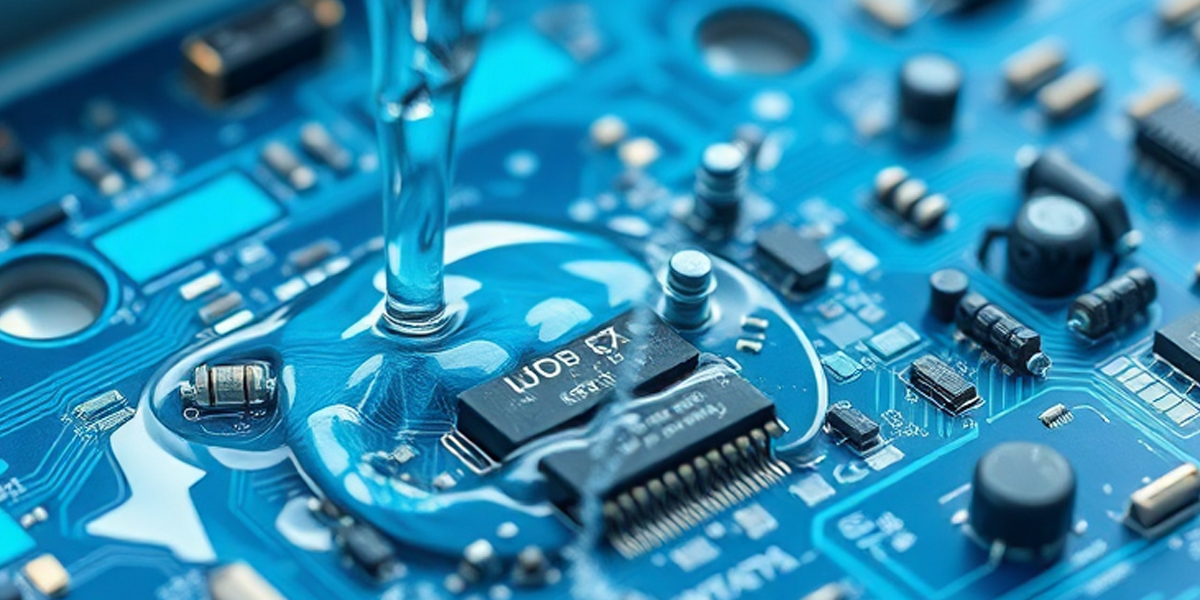
Adhesive R&D & ProductionMicro‑bubbles in epoxy structural adhesives reduce bonding strength and impair accuracy of mechanical‑property test data. Bubbles in sealants cause sealing failure after curing and leakage during pressure‑resistance tests. In adhesive R&D, bubble‑induced test deviations may lead to misjudgment in formula screening and prolong R&D cycles. | Precision Electronic AssemblyMicro‑bubbles in chip underfill adhesives form voids after reflow soldering and harm device reliability. Bubbles in conductive adhesives break conductive paths and trigger electronic component failure. Bubbles in dispensing adhesives bring uneven glue volume and degrade assembly precision and product consistency. | Biosensor ManufacturingBubbles in biosensor encapsulation glue destabilize signal transmission and cause fluctuating test results. Bubbles in reagent‑immobilized materials trigger uneven distribution of bioactive substances and weaken sensor response consistency. Bubbles in microfluidic chip‑bonding glue may block or leak channels and damage detection accuracy. |
✨ Dilemma of Traditional Methods: Conventional planetary stirring defoamers remove bubbles by centrifugal force, yet deliver limited performance on nano‑scale and deep‑seated bubbles inside high‑viscosity materials. The vacuum stirring‑defoaming solution applies ‑98kPa vacuum negative pressure during planetary stirring, expands microbubbles by boosting internal‑external pressure difference for bubble escape, and achieves in‑depth defoaming unavailable for ordinary stirring devices.
Why Choose SIE‑MIX60?
Three Core Advantages Tailored for Laboratory Vacuum Defoaming R&D
In‑depth Vacuum DefoamingMIX60ZK is equipped with ‑98kPa vacuum system as standard, vacuum defoaming function is available without extra option. On the basis of removing large bubbles via centrifugal force generated by planetary stirring, vacuum negative pressure further eliminates nano‑scale microbubbles and deep‑seated bubbles hard to remove by centrifugal force. Combined with 3000rpm high‑speed rotation and vacuum negative pressure, stirring and defoaming proceed simultaneously to realize in‑depth defoaming in one cycle, ideal for material R&D with strict bubble‑rate requirements. | Precision Small‑batch Sample Processing300 mL capacity matches daily laboratory R&D dosage, meeting sample preparation demands while avoiding material waste. Dual‑cup design enables simultaneous processing of two samples for comparison tests and process verification. 100‑recipe storage function saves parameters including vacuum level, rotating speed and time with one click. Different vacuum defoaming processes for various materials can be recalled for reproduction to guarantee repeatable test data. | Reproducible Process ParametersTouch‑screen operation enables precise adjustment of vacuum level, rotation speed, time and other parameters to ensure consistent processing conditions for every run. Optional MES network‑access function automatically uploads processing data to satisfy R&D traceability requirements. Full‑process traceable and reproducible workflow from vacuum defoaming parameter setting to data recording fits R&D projects requiring strict process management. |
✨ MIX60 integrates three core capabilities of in-depth vacuum defoaming, precision small-sample processing and reproducible process parameters, serving as an ideal device for vacuum-assisted defoaming in laboratory R&D.
Working Principle
Dual synchronous revolution and rotation power, combined with vacuum negative pressure, realizes in-depth defoaming.
Step 1: Centrifugal Force Generated by Revolution The revolving disc rotates at high speed to generate strong centrifugal force for materials inside the container, driving full‑range material convection to achieve macro‑mixing. Meanwhile, centrifugal force pushes low‑density bubbles toward the rotating axis and facilitates aggregation and escape of large bubbles. Step 2: Shear Force Provided by Rotation The container spins around its own axis to generate directional shear force, breaking agglomerated particles for micro‑dispersion. 3000rpm high‑speed rotation delivers powerful shear force for efficient full‑range mixing. The shear force also thins bubble walls and accelerates bubble rupture. Step 3: Enhanced Defoaming via Vacuum Negative Pressure While revolution and rotation stirring is in progress, the vacuum system reduces chamber pressure to ‑98kPa. Increased pressure difference inside and outside bubbles under low‑pressure environment expands nano‑scale microbubbles and speeds up their floating‑out. Vacuum defoaming compensates for insufficient centrifugal‑force removal of tiny bubbles, realizing full‑range defoaming from large bubbles down to nano‑scale bubbles. Revolution, rotation and vacuum work synchronously. Materials complete the whole process of "Mixing → Dispersion → In‑depth Defoaming" inside sealed containers. 3000rpm high rotation speed cooperates with ‑98kPa vacuum to balance mixing efficiency and defoaming depth. | 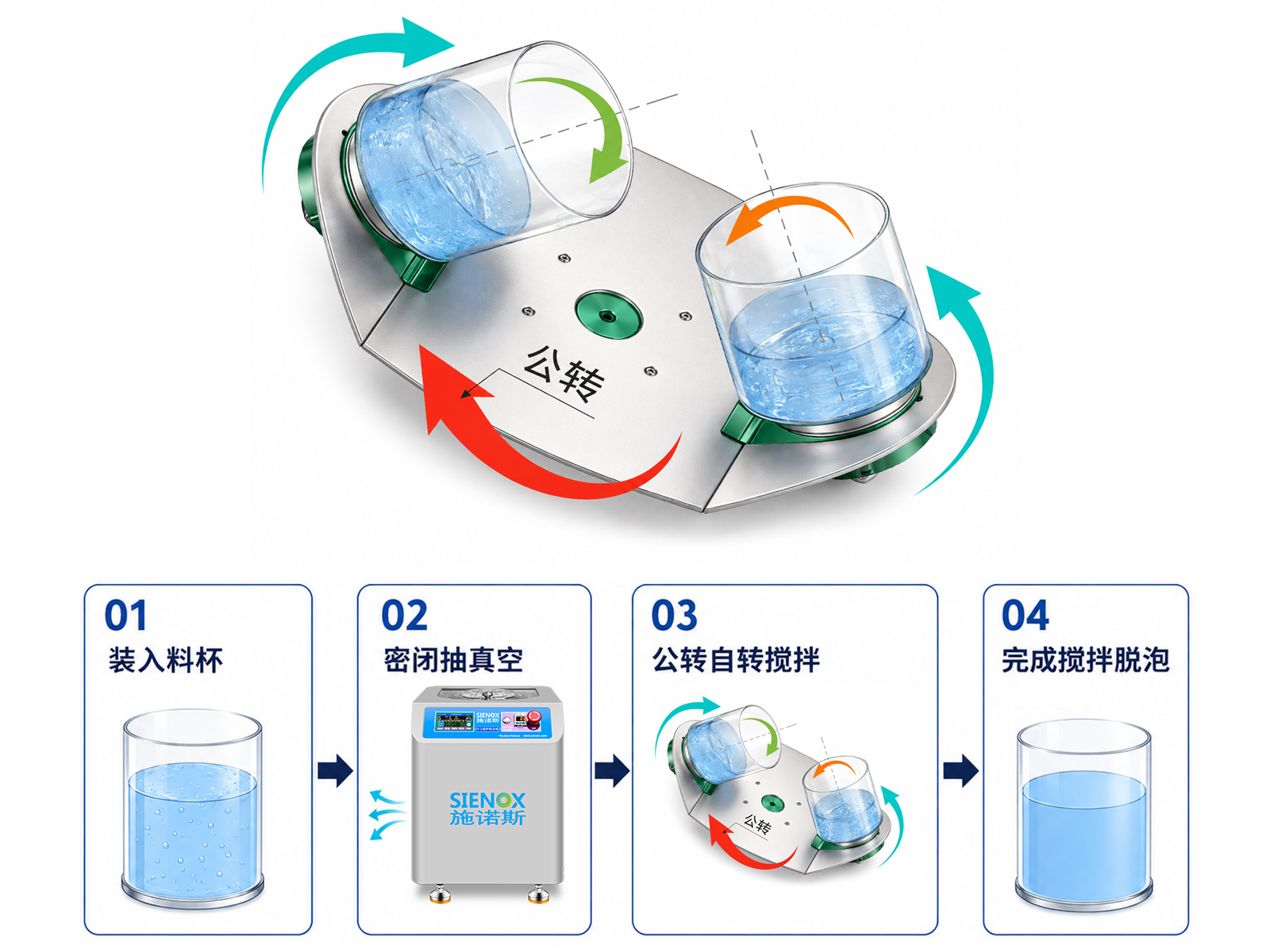 |
Quick Technical Specifications
Complete Technical Specifications Overview, Customizable on Demand
| Equipment Model | SIE‑MIX60 |
| Mixing Capacity | 0–300 mL (standard container) * Larger volume customizable |
| Container Type | Test tube / Jar / Cup; adapters for syringes and cartridges available |
| Container Quantity | 1 or 2 jars (user‑selectable) |
| Max Rotation Speed | 0 – 3000 RPM (stepless adjustable) |
| Revolution / Rotation Ratio | Fixed planetary ratio |
| Vacuum Level | Standard: –98 kPa / Optional: –100 kPa |
| Control System | Touch screen, stores 100 sets of formula parameters |
| Power Supply | 220V, 50/60Hz (110V US/JP standard customizable) |
| Overall Dimension(W×D×H) | 510 × 430 × 500 mm |
| Net Weight | Approx. 95 kg |
| Certifications | CE, ISO9001, RoHS Compliance |
我们的合作伙伴
深受全球知名工业制造集群及前沿高校实验室信赖
FAQ 您关心的问题
为您解答关于产品性能及日常工艺选型中的常见疑问
-
真空脱泡搅拌机是什么?用于哪些行业?
真空脱泡搅拌机是在真空环境下同步完成搅拌与脱泡的设备,脱泡同时混料,避免二次气泡混入,常用于环氧树脂、硅胶、AB 胶等高粘度材料的混料脱泡处理,广泛应用于新能源电池、半导体封装、LED、电子灌封、胶粘剂等行业。
-
广州施诺斯主要生产哪些设备?
主要产品包括搅拌脱泡机、真空脱泡搅拌机、真空脱泡机、高压脱泡机、真空搅拌机、实验室均质机、三辊研磨机、三维混粉机,以及点胶机、分装机等配套设备和夹具、搅拌罐、针筒等辅品耗材。
-
源头厂家采购脱泡设备有什么优势?
源头厂家直供可省去中间环节,价格更透明,同时能提供参数定制、来料试机、工艺验证等服务,售后响应更直接。
-
搅拌脱泡机的工作原理?
施诺斯设备采用行星式混合原理:料罐在自转的同时绕公转轴公转,物料在罐内随之翻动混合,同时抽真空脱泡。整个过程设备不设搅拌桨,搅拌部件不接触物料,不会引入金属异物,混合均匀不分层。
-
为什么选择施诺斯?
施诺斯(SIENOX)是广州施诺斯科技股份有限公司旗下品牌,2014 年成立,专注脱泡机与搅拌机的研发与制造,团队自 2006 年起从事真空搅拌脱泡设备研发。设备采用非接触式设计,不设搅拌桨,行星式公转加自转运动辅以真空系统,高效除泡,混合均匀不分层。公司产品涵盖搅拌脱泡机、真空脱泡搅拌机、真空脱泡机、高压脱泡机、真空搅拌机、实验室均质机、三辊研磨机、三维混粉机,以及点胶机、分装机等配套设备和夹具、搅拌罐、针筒等辅品耗材,广泛应用于新能源、半导体、LED、电子灌封、胶粘剂、涂料、油墨等行业。通过 ISO9001、CE 认证,拥有 30 余项专利,服务富士康、比亚迪、清华大学等企业与科研院所。
Technical Specification List
Full‑line parameter specifications to assist your accurate process‑model selection
| Equipment Model | SIE‑MIX60 | SIE‑MIXF301 | SIE‑MIX90 |
| Mixing Capacity | 0–300 mL (standard container) * Customizable | 0–300 mL (standard container) * Customizable | 0–1000 mL (standard container) * Customizable |
| Container Type | Test tube / Jar / Cup; adapters for syringes and cartridges available | Test tube / Jar / Cup; adapters for syringes and cartridges available | Test tube / Jar / Cup; adapters for syringes and cartridges available |
| Container Quantity | 1 or 2 jars (user‑selectable) | 1 or 2 jars (user‑selectable) | 1 or 2 jars (user‑selectable) |
| Max Rotation Speed | 0 – 3000 RPM (stepless adjustable) | 0 – 2000 RPM (stepless adjustable) | 0 – 2000 RPM (stepless adjustable) |
| Revolution / Rotation Ratio | Fixed planetary ratio | Freely adjustable | Fixed planetary ratio |
| Vacuum Level | Standard: –98 kPa / Optional: –100 kPa | Standard: –98 kPa / Optional: –100 kPa | Standard: –98 kPa / Optional: –100 kPa |
| Control System | Touch screen, stores 100 sets of formula parameters | Touch screen, stores 100 sets of formula parameters | Touch screen, stores 100 sets of formula parameters |
| Power Supply | 220V, 50/60Hz (110V US/JP standard customizable) | 220V, 50/60Hz (110V US/JP standard customizable) | 220V, 50/60Hz (110V US/JP standard customizable) |
| Overall Dimension(W×D×H) | 510 × 430 × 500 mm | 510 × 430 × 500 mm | 610 × 560 × 780 mm |
| Net Weight | 95 kg | 115 kg | 153 kg |
*** Above are typical models only. SIENOX provides customized solutions per‑customer requirements. Contact for model selection: 189‑2512‑9293
Multi‑Industry Solutions
Covering stirring and debubbling applications of typical materials across six major industries
Adhesive R&DEpoxy structural adhesives, sealants, hot‑melt adhesives, pressure‑sensitive adhesives, modified adhesives |
Precision Electronic AssemblyUnderfill adhesives, conductive adhesives, die‑attach pastes, dispensing adhesives, chip bonding adhesives |
BiosensorsEncapsulation glue, reagent immobilized materials, microfluidic bonding glue, biocompatible glue, sensor sealing glue |
Microelectronic PackagingPackaging epoxy glue, molding compound, lead bonding glue, substrate bonding glue, passivation layer materials |
Functional CoatingsHydrophobic coatings, conductive coatings, insulating coatings, anti‑corrosion coatings, wear‑resistant coatings |
Electronic PastesSilver paste, copper paste, carbon paste, resistor paste, dielectric paste |
Comprehensive Equipment Operation Demo Videos
Gain intuitive, clear, dynamic insight into synchronous defoaming with planetary centrifugal force and high negative pressure.
Measured Defoaming‑Process Performance
Measured Processing Results for Six Typical Materials
Paste‑like Materials |
Glue with Powder |
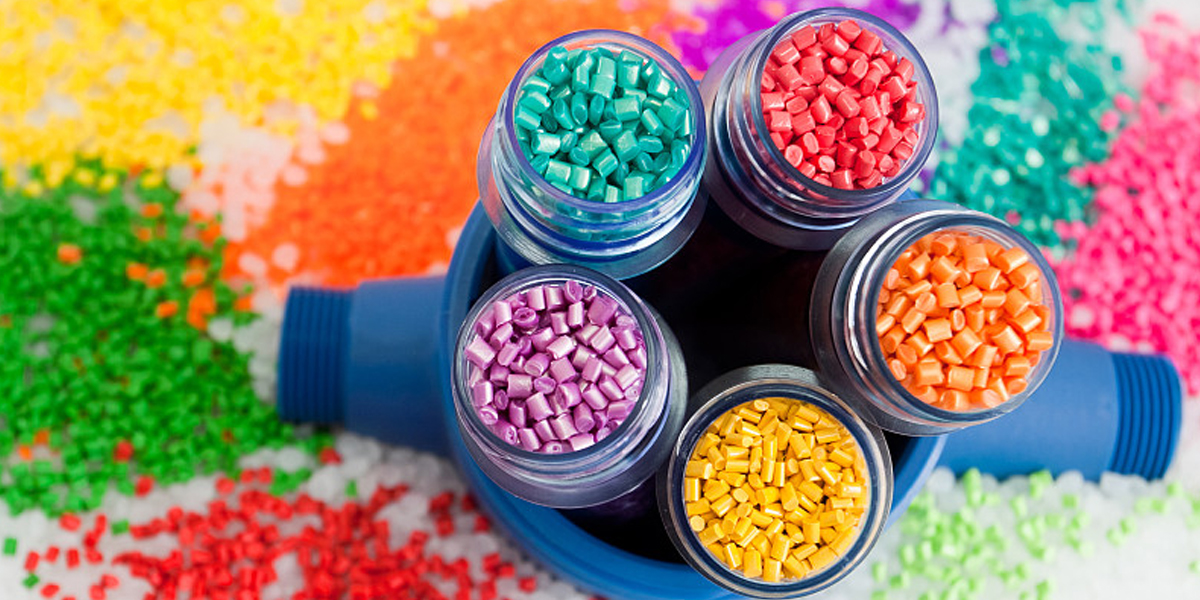
Polymer Materials |
Pharmaceutical Gels |
Silver Paste Materials |
Battery Slurries |
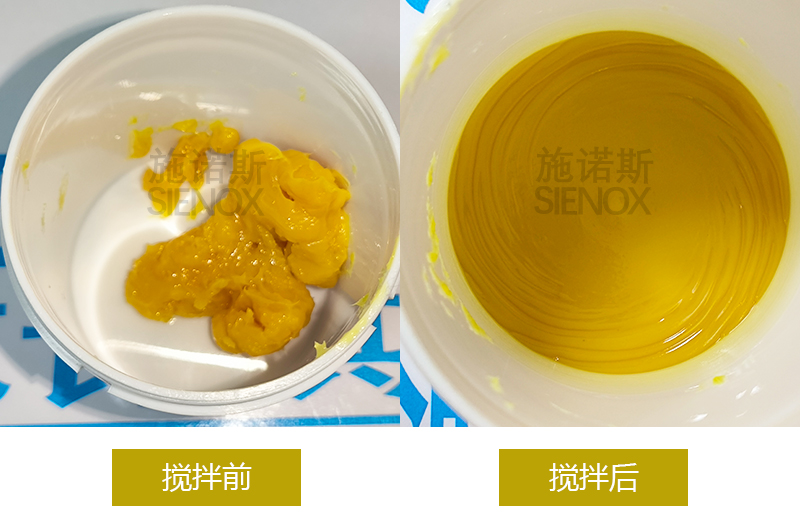
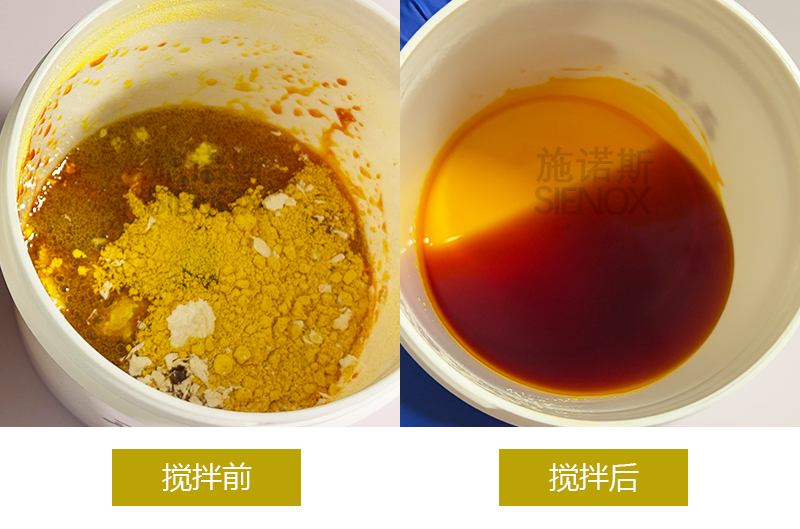
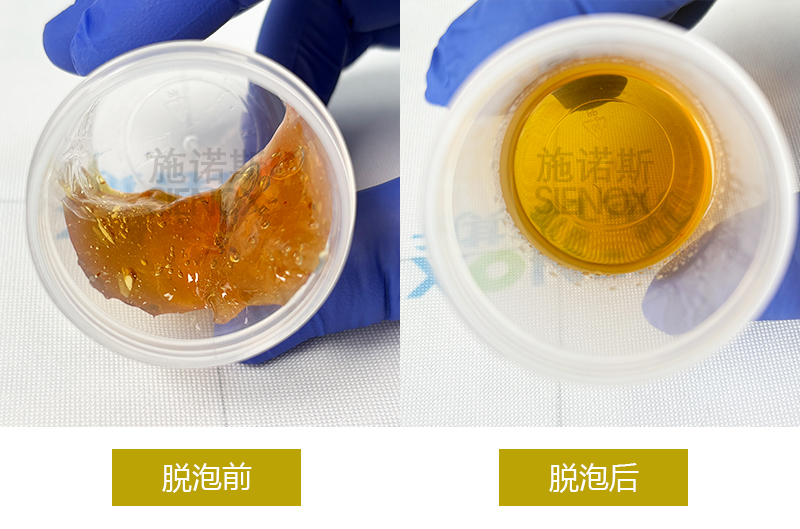
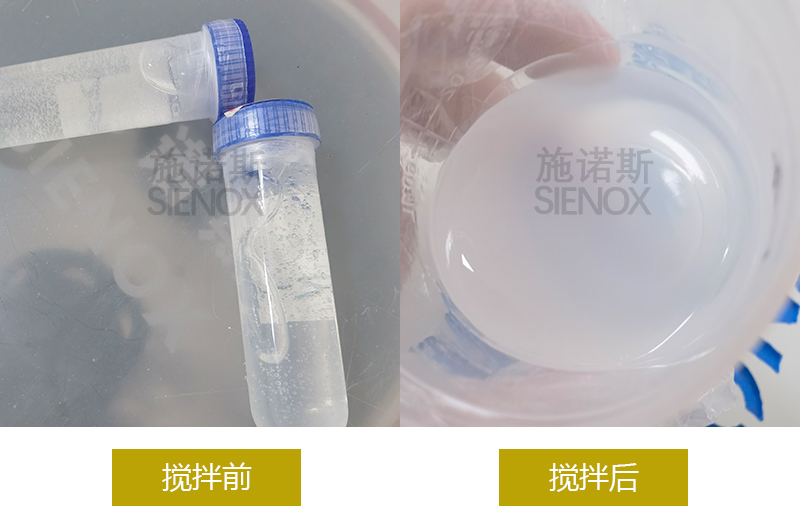
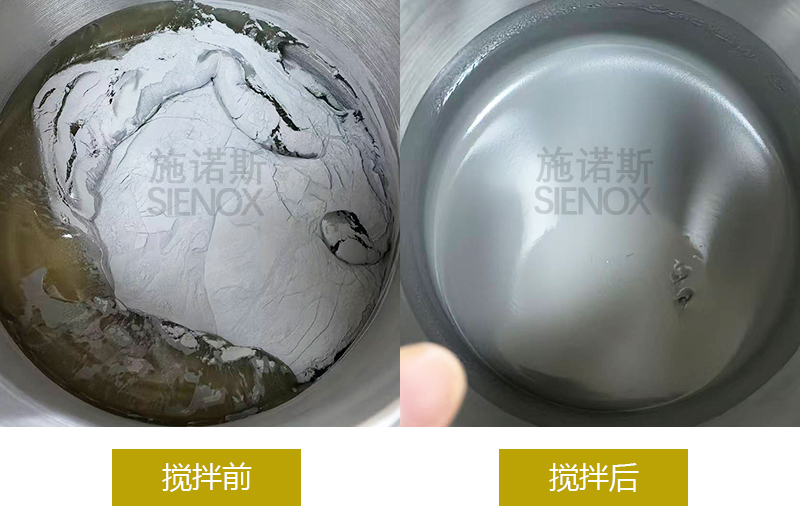
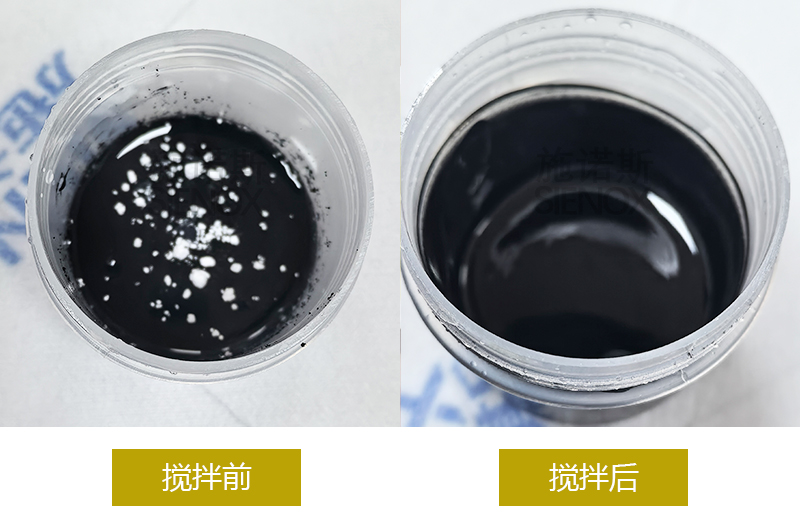
Measured Data Comparison
Comparison of Defoaming Effects for Three Representative Materials
| Material Type | Pre‑treatment Status | Post‑treatment by MIX60 |
| Silver Paste | Visible bubbles covering paste surface, uneven silver powder distribution with obvious agglomeration and precipitation | Smooth and dense paste surface, uniformly dispersed silver powder without agglomeration, good fluidity and stable conductivity |
| Battery Cathode Slurry | Massive internal bubbles, poor fluidity, stripes and pinholes during coating | Uniform and fluent slurry with zero residual bubbles, flat smooth coated surface and consistent coating thickness |
| Epoxy Adhesive (AB Glue) | Dense micro‑bubbles inside mixed glue, milky turbid appearance, uneven surface after curing | Transparent clear glue with no visible bubbles, flat smooth cured surface and dense void‑free cross‑section |
* Internal lab test data. Actual improvement varies with material formulas. Real customer cases available upon request from sales.
Customer Delivery & Application Cases
Rooted in manufacturing frontlines, empowering benchmark production lines and key national research institutions across diverse industries.
Stirring & Defoaming Solution for Powders and Fluids |
AB Structural Adhesive Mixing & Defoaming Solution |
Mixing and Defoaming Solution for High‑Viscosity Colloid and Phosphor Powder Materials |